Financial Planning / Education
Should I Pay Down Debt Before I Start Investing?
Educational article
This article is generic financial education based on public sources. It is not a product recommendation or personal financial advice.
Quick answer
As a general guideline, high-cost unsecured debt should be prioritised and cleared before directing money into investments, whereas lower-cost structured loans can often be serviced concurrently with a regular investment plan.
Have a question about your own situation?
If this article raised a question about your own situation, you can message Danny directly and ask what information would be useful to prepare before a proper discussion.

Written by
Danny ChuaFinancial Consultant · Representing Prudential Assurance Company Singapore (Pte) Limited
MAS Representative Number CCS300848890 · BSc. Pharm. Sci.
Published 2026-09-13 · Updated 2026-09-13
For anyone taking their first steps into personal finance, deciding whether to pay off existing borrowing or begin investing can feel like an impossible choice. You might hear advice insisting that you should put money into the market as early as possible to take advantage of compound growth. At the same time, carrying loans creates an ongoing monthly obligation and interest expense.
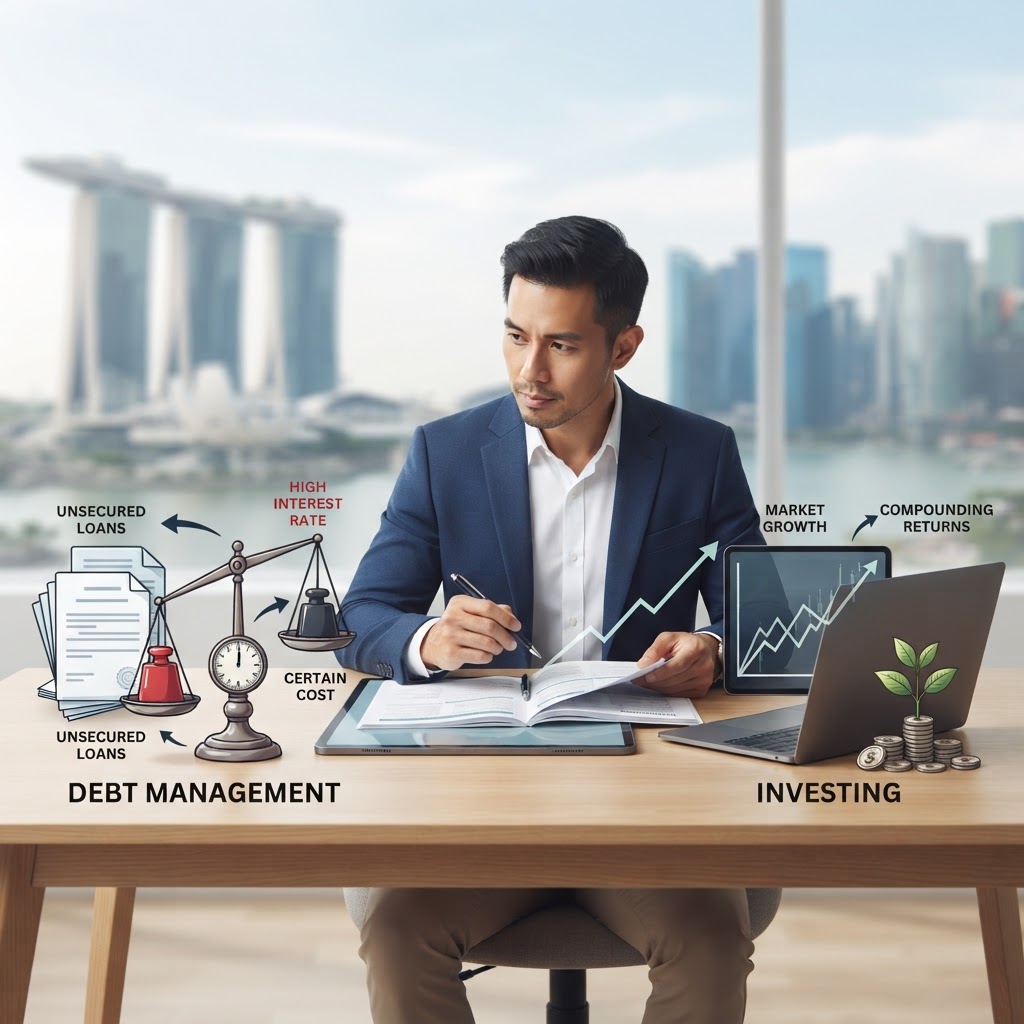
Navigating this choice does not require guessing market directions. Instead, it comes down to comparing the certain financing cost of your liabilities against the variable nature of investment outcomes.
The Mathematical Reality: Certain Cost vs. Uncertain Outcomes
When evaluating debt alongside investing, the primary factor is the Effective Interest Rate (EIR) of what you owe compared to the non-guaranteed nature of investment returns.
Every dollar used to eliminate debt delivers a specific, guaranteed financial benefit: you immediately avoid paying that loan's interest rate. For example, if you hold an unsecured credit balance charging a high annual financing cost, paying off that balance provides a definite saving equivalent to that exact interest rate. No further financing charges accumulate on that cleared sum.
In contrast, investing in securities, mutual funds, or exchange-traded funds involves market risk. Investment performance fluctuates, capital is not preserved, and non-guaranteed values are merely projections that may be nil. Even when broad markets have historically trended upward over decades, there can be multi-year downturns or periods of capital losses.
If you direct cash into market investments while holding high-interest borrowing, your portfolio would have to achieve continuous, extraordinary gains just to break even after accounting for your loan's ongoing interest charges and investment fees. Because market returns are uncertain while loan charges are contractually enforced, holding expensive debt while trying to invest generally puts your overall net worth at a mathematical disadvantage.
Ordering Your Loans: The Cost Hierarchy
Not all debts carry the same impact on your monthly budget. According to MoneySense Singapore, an effective approach to managing debt is to list all your outstanding obligations by their interest rates and prioritise paying off those with the highest rates first.
To see where your finances stand, categorize your obligations into two distinct groups:
1. High-Cost Unsecured Debt
This category includes credit card balances, rollover balances, and unsecured personal lines of credit.
- The Nature of the Cost: In Singapore, credit card financing costs frequently range around 26% to 28% per annum. Personal loans can also carry significant effective interest rates once all administrative fees and compounding periods are factored in.
- The Impact: Interest charges on credit cards compound rapidly if the balance is not cleared in full each month. Trying to generate investment returns that reliably outpace a 26% annual drag is unrealistic.
- The Action: National financial guidance strongly recommends clearing these obligations before putting money into volatile investment vehicles.
2. Lower-Cost, Asset-Backed Borrowing
This group comprises structured, long-term facilities, such as residential property mortgages (such as an HDB concessionary loan or bank home loan).
- The Nature of the Cost: These loans are secured against real property and generally carry significantly lower annual interest rates compared to unsecured personal borrowing.
- The Impact: Because the annual borrowing cost is relatively low and spread across 15 to 30 years, paying off the principal early may not always need to take absolute precedence over beginning a long-term investment horizon.
- The Action: It is common for individuals to maintain their standard, scheduled loan repayments while directing surplus monthly savings into long-term investment vehicles.
A Plain-Language Calculation Method
To make this decision personal to your current financial position, you do not need complex modelling tools. You can run a straightforward evaluation using your actual monthly numbers:
- Identify the Effective Interest Rate (EIR): Review your loan statements or bank facilities. Do not rely solely on the advertised 'flat rate' for instalment plans, as flat rates understate true borrowing costs. Check the formal EIR disclosed on your statement.
- Compare Against Conservative Expectations: Compare this loan EIR against a realistic long-term expected return from a diversified portfolio, net of all platform, management, and transaction fees. Remember that investment returns are exposed to volatility and non-guaranteed results, while the loan cost is fixed and legally required.
- Assess Your Cash Flow Margin: If your borrowing costs sit in the double digits or high single digits, the optimal path for your monthly cash flow is to apply extra payments toward eliminating that balance.
Non-Obvious Pitfalls for Beginners
When managing debt alongside investing, beginners frequently encounter a few subtle traps:
- Investing Without an Emergency Buffer: Some beginners commit every spare dollar either to aggressive loan repayment or to new investment accounts without holding liquid savings. If an unexpected expense arises—such as urgent dental care or a job disruption—they may be forced to incur new credit debt or liquidate investments during a market downturn. Maintaining an accessible cash reserve is an essential foundation before expanding investment allocations.
- The Psychological Stress of Market Drawdowns: It is one thing to compare theoretical numbers on paper; it is another to endure market volatility in real life. If you are servicing debt each month while watching an investment portfolio drop during a market correction, the emotional strain can prompt hasty decisions, such as selling at the bottom. Clearing debts reduces mandatory monthly overhead, which can improve your resilience during market downturns.
- Minimum Payment Illusion: Paying only the minimum sum on a credit card prevents immediate late fees, but it prolongs compounding interest over years. If you hold unsecured credit card debt, paying only the minimum while investing the remainder often results in an overall net financial loss.
How to Build Your Next Action Plan
If you find yourself carrying loans while wanting to build long-term wealth, consider taking these sequential steps:
- Maintain Essential Liquidity: Keep a basic emergency fund in an ordinary bank account to handle unexpected short-term needs without borrowing.
- Eliminate High-Cost Balances: Direct all available surplus savings toward clearing credit cards, credit lines, or high-interest personal loans. As advised by MoneySense Singapore, attack the highest-interest facility first while keeping up with required minimums across all other facilities.
- Transition to Investing with Lower-Cost Facilities: Once high-cost unsecured balances are cleared, evaluate your long-term goals. If your remaining obligations are lower-rate facilities, such as a housing loan, you can design a balanced framework: meet your regular debt instalments punctually, avoid taking on new high-interest borrowing, and allocate a sustainable monthly sum into long-term investments suited to your horizon and risk profile.
New to investing and still unsure where to start? You can ask Danny a question before deciding whether any next step is appropriate for you.
Frequently Asked Questions
Should I pay down debt before I start investing?
It comes down to comparing the certain financing cost of your liabilities against the variable nature of investment outcomes. Paying off debt delivers a definite saving equivalent to that loan's interest rate, while investment performance fluctuates, capital is not preserved, and non-guaranteed values may be nil. Holding expensive debt while trying to invest generally puts your overall net worth at a mathematical disadvantage.
Which debts should I deal with first?
According to MoneySense Singapore, an effective approach is to list all your outstanding obligations by their interest rates and prioritise paying off those with the highest rates first, while keeping up with required minimums on the others. High-cost unsecured debt such as credit card balances, rollover balances and unsecured personal lines of credit is the category to clear before putting money into volatile investment vehicles.
Is a housing loan treated the same as credit card debt?
No. Residential property mortgages are secured against real property and generally carry significantly lower annual interest rates than unsecured personal borrowing. Paying off the principal early may not always need to take absolute precedence over beginning a long-term investment horizon, and it is common to maintain scheduled loan repayments while directing surplus monthly savings into long-term investments.
How do I compare my loan with an investment?
Identify the Effective Interest Rate (EIR) shown on your loan statement rather than relying on the advertised flat rate, which understates true borrowing costs. Compare it against a realistic long-term expected return net of all fees, remembering that investment returns are non-guaranteed while the loan cost is fixed and legally required.
What mistakes should beginners avoid when balancing debt and investing?
Committing every spare dollar to loan repayment or investing without holding liquid savings, underestimating the stress of market drawdowns while servicing debt, and paying only the minimum on a credit card, which prolongs compounding interest over years.
Key Takeaways
- Eliminating high-interest debt provides a definite financial saving equal to the loan's interest rate, whereas investment returns are variable and carry market risk.
- Unsecured debts like credit card balances carry high compounding rates and should be cleared before deploying capital into the market.
- Lower-rate, long-term facilities like housing loans can generally be serviced concurrently with a regular, diversified investment plan.
- Always check the Effective Interest Rate (EIR) rather than the advertised flat rate when evaluating the true cost of borrowing.
- Maintaining an emergency cash buffer is essential before aggressively tackling loans or starting investment plans to prevent taking on new debt.
Sources
- Managing debt: What can you do? - MoneySense Singapore (accessed 2026-03-30)
- Credit Limit Management Measure - Monetary Authority of Singapore (accessed 2026-03-30)
- Financial advisory process - MoneySense (accessed 2026-09-13)
About Danny
Danny Chua is a Financial Consultant Representing Prudential Assurance Company Singapore (Pte) Limited. MAS Representative Number CCS300848890. Qualification: BSc. Pharm. Sci.. Read more about Danny.
Related Guidance
Prudential Assurance Company Singapore (Pte) Limited (PACS) is the insurer referred to in this disclaimer. Investment products are subject to investment risks including the possible loss of the principal amount invested. The figures stated relating to PACS products are for illustrative purposes only. The information presented is for your information only and does not consider specific investment objectives, financial situation or needs of any person. We recommend that you seek advice from a PACS Financial Consultant before making a commitment to purchase a Prudential policy.
This advertisement has not been reviewed by the Monetary Authority of Singapore. Investment products are subject to investment risks including the possible loss of the principal amount invested. The information presented is for your information only and does not consider specific investment objectives, financial situation or needs of any person. Seek advice from a Prudential Financial Consultant before making a commitment. This is Danny Chua's personal professional website and is not Prudential's official corporate website.