Investing Basics / Education
Should a Beginner Invest Monthly or Invest a Lump Sum?
Educational article
This article is generic financial education based on public sources. It is not a product recommendation or personal financial advice.
Quick answer
Whether a beginner should invest monthly or invest a lump sum depends primarily on cash flow availability, emotional comfort with market volatility, and the transaction fee structure of the chosen investment vehicle.
Have a question about your own situation?
If this article raised a question about your own situation, you can message Danny directly and ask what information would be useful to prepare before a proper discussion.

Written by
Danny ChuaFinancial Consultant · Representing Prudential Assurance Company Singapore (Pte) Limited
MAS Representative Number CCS300848890 · BSc. Pharm. Sci.
Published 2026-09-12 · Updated 2026-11-08
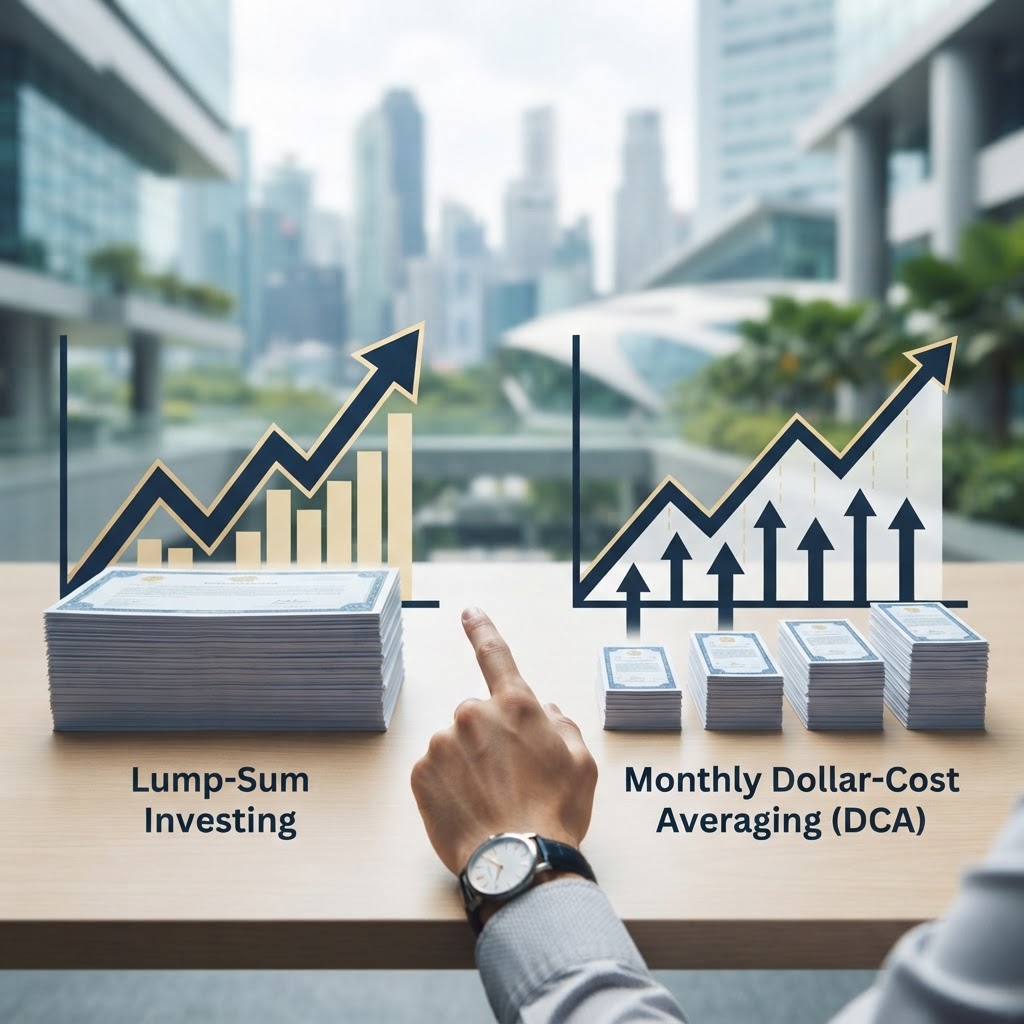
For anyone taking their first steps into the world of investing in Singapore, deciding how to allocate money into the market can feel intimidating. Two primary methods exist for putting your funds to work: investing a lump sum all at once, or committing smaller amounts on a recurring monthly basis—often referred to as dollar-cost averaging (DCA).
Understanding how each approach operates at a mechanical level allows you to align your strategy with your regular cash flow, time horizon, and personal comfort with market movements.
The Mechanics of Lump-Sum Investing
Lump-sum investing means deploying all your investable funds into selected securities or funds at a single point in time.
How It Functions in the Market
When you invest a lump sum, your entire principal begins participating in the market immediately. Over long multi-year horizons, financial markets historically spend more time rising than falling, as economic productivity and corporate earnings generally expand. By having all capital deployed on day one, you maximise market exposure time.
The Emotional and Timing Trade-Off
The main friction point with lump-sum investing is market timing sensitivity. If you commit an entire sum immediately before a sharp market decline, the nominal value of your portfolio will decrease in the near term. While long-term market recovery may occur over your time horizon, holding through an early unrealised decline requires substantial emotional resilience and financial stability.
The Mechanics of Monthly Regular Investing (Dollar-Cost Averaging)
Monthly investing involves committing a fixed amount of cash at fixed calendar intervals—such as on the day your salary is credited—regardless of whether asset prices are rising or falling.
How Dollar-Cost Averaging Manages Unit Prices
Because the invested dollar amount remains constant each month, the number of fund units or shares you acquire automatically changes depending on prevailing prices:
- When prices are higher: Your fixed monthly sum buys fewer units.
- When prices fall: Your fixed monthly sum automatically buys a larger number of units.
Over multiple market cycles, this recurring discipline smooths your average purchase cost per unit. Instead of trying to guess whether the market has peaked or bottomed out, you systematically spread out your entry points across different price levels.
The Cash Drag Consideration
The trade-off with monthly investing occurs when you already hold a substantial pool of idle cash. By dripping funds into the market over six, twelve, or eighteen months, uninvested cash sits on the sidelines. If the underlying asset rises steadily over that period, each subsequent tranche purchases fewer units at progressively higher prices, resulting in an average purchase price higher than a day-one lump sum entry.
How to Calculate and Evaluate the Two Approaches
To evaluate both options objectively without guesswork, you can run a clear self-assessment based on your financial foundation.
1. Establish Your Emergency Buffer First
Before choosing any deployment rhythm, check that your liquid safety reserves are completely separate. As noted by national financial education resources like MoneySense, investing should only be undertaken with funds not earmarked for immediate spending or emergency savings. Money required for short-term liabilities within the next few months or years should not be exposed to investment market volatility.
2. Identify Your Cash Inflow Profile
Most working beginners do not have a large idle sum sitting in a bank account. For salaried employees earning a regular monthly wage, monthly regular investing is a natural operational match: you invest directly from regular cash surplus each month.
Conversely, if you receive a specific one-off capital inflow—such as an annual bonus, maturity payout, or accumulated savings beyond your emergency buffer—you face the genuine operational choice between committing that capital at once or breaking it into scheduled monthly tranches.
3. Check Fixed Transaction Costs and Account Drag
A critical pitfall for beginners is failing to verify fee schedules. Different brokerage platforms, unit trust platforms, or insurance policies charge different fee structures:
- Fixed minimum transaction fees: If a platform charges a fixed fee per transaction (for instance, a flat fee for every trade execution), investing very small monthly sums can cause transaction fees to consume a disproportionately large percentage of your capital.
- Percentage-based fees: Platforms that charge a purely proportional platform or custody fee without high fixed minimums are generally more suitable for recurring, smaller monthly commitments.
To assess the fee impact on your strategy, calculate the ratio of the execution fee relative to your planned transaction size:
Transaction cost ratio = fee per transaction ÷ amount invested per transaction
If the fee per transaction represents a noticeable percentage of the monthly sum, adjusting your contribution frequency (e.g., quarterly rather than monthly) or reviewing platform fee tiers can help reduce fee drag.
Important Non-Guaranteed Realities and Risk Considerations
Regardless of whether capital enters the market via a lump sum or monthly instalments, several core principles apply to both:
- Non-guaranteed performance: Returns on market-linked securities, mutual funds, and investment-linked policy sub-funds are non-guaranteed. Asset values and fund units can fluctuate downwards as well as upwards, and past historical index results do not guarantee future returns. Projected returns in illustrative materials are non-guaranteed and may be nil.
- Diversification scope: Spreading purchases over time or across different funds reduces specific concentration risks, but diversification does not eliminate market risk, currency risk, or macroeconomic downturns.
- Early exit costs: For contractual products or investment-linked policies, early termination or surrender can involve substantial charges, resulting in a payout that may be zero or significantly less than the total capital contributed. Policyholders should carefully inspect the relevant Product Summary and Product Highlights Sheet before committing.
Verifying Your Readiness
A beginner can systematically review their situation with three checks before selecting a deployment method:
- Do I have an emergency cushion intact? Confirm that essential living expenses are secured in liquid savings before directing any money into investments.
- Is my source of capital regular income or a single pool? Match regular monthly income to automatic monthly investing, and evaluate lump sums against your emotional capacity to endure near-term market fluctuations.
- What are the platform's minimum fees per order? Verify that repeated monthly purchases will not be eroded by recurring transaction charges.
New to investing and still unsure where to start? You can ask Danny a question before deciding whether any next step is appropriate for you.
Key Takeaways
- Lump-sum investing deploys all funds immediately, maximising time in the market but requiring comfort with short-term price fluctuations.
- Dollar-cost averaging (DCA) commits fixed amounts at regular intervals, automatically buying more units when prices dip and fewer when prices rise.
- For beginners relying on a monthly salary, recurring monthly contributions naturally mirror cash flow without needing to time the market.
- Fixed transaction fees can erode small monthly investments; review platform cost structures to avoid unnecessary fee drag.
- Investment returns on market instruments and sub-funds are non-guaranteed, and projections may be nil.
Sources
- Investing - MoneySense - MoneySense Singapore (accessed 2026-03-30)
- Financial advisory process - MoneySense (accessed 2026-09-12)
About Danny
Danny Chua is a Financial Consultant Representing Prudential Assurance Company Singapore (Pte) Limited. MAS Representative Number CCS300848890. Qualification: BSc. Pharm. Sci.. Read more about Danny.
Related Guidance
Prudential Assurance Company Singapore (Pte) Limited (PACS) is the insurer referred to in this disclaimer. Investment products are subject to investment risks including the possible loss of the principal amount invested. The figures stated relating to PACS products are for illustrative purposes only. The information presented is for your information only and does not consider specific investment objectives, financial situation or needs of any person. We recommend that you seek advice from a PACS Financial Consultant before making a commitment to purchase a Prudential policy.
This advertisement has not been reviewed by the Monetary Authority of Singapore. Investment products are subject to investment risks including the possible loss of the principal amount invested. The information presented is for your information only and does not consider specific investment objectives, financial situation or needs of any person. Seek advice from a Prudential Financial Consultant before making a commitment. This is Danny Chua's personal professional website and is not Prudential's official corporate website.