Investing Basics / Education
What are the core differences between market risk and liquidity risk?
Educational article
This article is generic financial education based on public sources. It is not a product recommendation or personal financial advice.
Quick answer
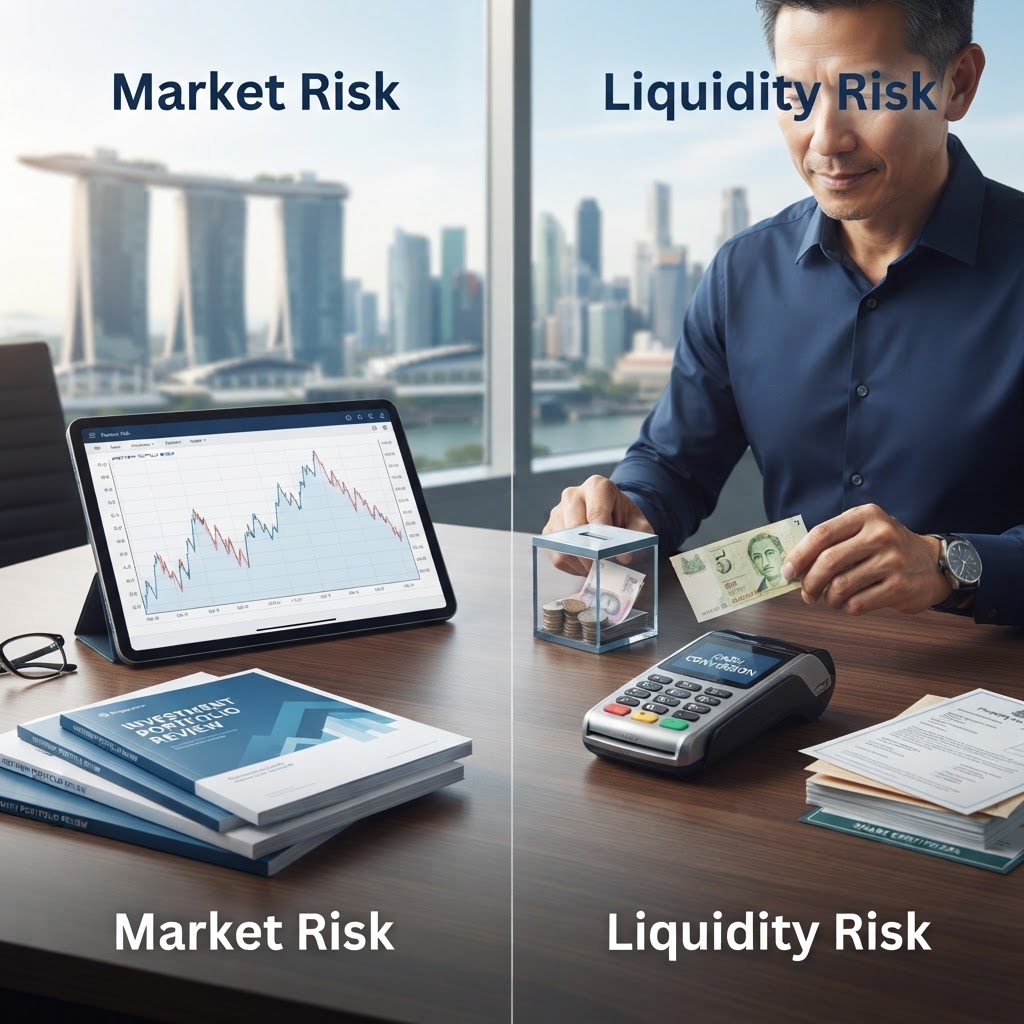
Market risk is the possibility of suffering losses due to fluctuations in asset prices, while liquidity risk is the inability to convert an investment into cash quickly without significantly affecting its price. Understanding both is essential for balancing your portfolio according to your investment horizon and liquidity needs.
Have a question about your own situation?
If this article raised a question about your own situation, you can message Danny directly and ask what information would be useful to prepare before a proper discussion.

Written by
Danny ChuaFinancial Consultant · Representing Prudential Assurance Company Singapore (Pte) Limited
MAS Representative Number CCS300848890 · BSc. Pharm. Sci.
Published 2026-11-04 · Updated 2026-11-17
Understanding the difference between various investment risks is a foundational step in building a resilient portfolio. Market risk and liquidity risk represent two distinct challenges that investors must navigate to align their holdings with their personal financial objectives. According to MoneySense, every investment bears risk, and recognizing these differences is critical for long-term planning.
What is market risk?
Market risk refers to the possibility that the value of your investments will fluctuate due to broader market conditions. When you hold assets like shares, you are exposed to the risk of price drops. If you want to clarify whether your portfolio is prepared for these shifts before deciding what to do next, you can understand low risk in investing: a guide for beginners to better align your strategy.
What is liquidity risk?
Liquidity risk is the potential challenge of not being able to access your invested capital when you need it. An asset is considered liquid if it can be sold easily and converted into cash without a substantial impact on its price. If you have immediate financial needs, it is important to understand why liquidity matters before choosing a long-term investment to ensure your money is accessible when required.
Key strategies to manage investment risks
According to MoneySense, you can manage these risks through several strategic approaches:
- Diversification: Spreading investments across a variety of assets that do not move in the same direction to reduce the impact of a single market downturn.
- Asset Allocation: Distributing your capital across different asset classes—such as shares and bonds—based on your risk appetite and investment objectives.
- Dollar-Cost Averaging: Investing a fixed sum at regular intervals, which allows you to buy more assets when prices are low and fewer when prices are high.
- Horizon Management: Aligning the duration of your investments with your specific life stage and goals to provide time to ride out market fluctuations.
Why do these risks matter for asset allocation?
Your asset allocation should reflect your ability to withstand both price volatility and the need for cash. For instance, if capital preservation is your primary objective, you might lean toward lower-risk assets. Conversely, if you have a longer investment horizon, you may have more time to recover from market price fluctuations. Always ensure that the products recommended to you are suitable by reviewing the full product documents, including the policy illustration or product summary, as noted by MoneySense.
Common misunderstandings
A common mistake is assuming that a long-term investment will always be available for immediate withdrawal without penalty or price impact. Investors often underestimate liquidity risk until they have an urgent need for cash. Additionally, some believe that dollar-cost averaging eliminates market risk entirely; while it helps manage timing risks, it does not prevent losses if the overall market value of the assets declines.
Frequently Asked Questions
Can I afford to lose my investment money?
Every investment carries the risk of loss, including the potential to lose part or all of your principal. You should assess your risk appetite based on your current commitments and your ability to absorb potential losses.
How do I know if an investment is liquid?
Liquid assets are those that can be sold quickly without significantly lowering their price. Before investing, check product disclosures to understand if there are specific conditions or waiting periods for withdrawals.
Are the projected returns in my document guaranteed?
No, product illustrations provided by your financial adviser are projections and not guarantees. Actual returns depend on market performance and associated product charges.
If you want to clarify this before deciding what to do next, you can WhatsApp Danny or request a conversation. Discussions can be arranged around work schedules, subject to availability.
Key Takeaways
- Market risk involves potential losses from price fluctuations, while liquidity risk relates to the difficulty of converting assets to cash without affecting value.
- Diversification helps reduce risk by spreading investments across assets that move independently of one another.
- Your asset allocation strategy should align with your specific investment objectives, time horizon, and risk appetite.
- Dollar-cost averaging is a disciplined strategy that can mitigate the risk of timing the market incorrectly.
- Investors should verify their financial adviser's credentials and carefully review all product documents before committing capital.
Sources
- Managing investment risk - MoneySense (accessed 2026-11-04)
- Financial advisory process - MoneySense (accessed 2026-11-04)
About Danny
Danny Chua is a Financial Consultant Representing Prudential Assurance Company Singapore (Pte) Limited. MAS Representative Number CCS300848890. Qualification: BSc. Pharm. Sci.. Read more about Danny.
Related Guidance
Prudential Assurance Company Singapore (Pte) Limited (PACS) is the insurer referred to in this disclaimer. Investment products are subject to investment risks including the possible loss of the principal amount invested. The figures stated relating to PACS products are for illustrative purposes only. The information presented is for your information only and does not consider specific investment objectives, financial situation or needs of any person. We recommend that you seek advice from a PACS Financial Consultant before making a commitment to purchase a Prudential policy.
This advertisement has not been reviewed by the Monetary Authority of Singapore. Investment products are subject to investment risks including the possible loss of the principal amount invested. The information presented is for your information only and does not consider specific investment objectives, financial situation or needs of any person. Seek advice from a Prudential Financial Consultant before making a commitment. This is Danny Chua's personal professional website and is not Prudential's official corporate website.